Signs you need full mouth reconstruction include chronic jaw pain, teeth worn down to nubs, multiple failing crowns or fillings, a bite that no longer closes properly, and losing several teeth across both arches. When three or more of these show up together, a single filling or crown won’t fix the underlying problem.
Most people don’t wake up one day needing a full rebuild of their mouth. It builds slowly, usually over 10 to 20 years, through a combination of untreated decay, grinding, old dental work that’s failing, and gum disease that’s gone unmanaged. By the time someone notices, they’ve often already lost bone, shifted their bite, or cracked several teeth.
Full mouth reconstruction isn’t a single procedure. It’s a coordinated treatment plan that can include dental crowns, bridges, implants, and sometimes orthodontic movement, all planned together so the bite functions as one system instead of a collection of patched-up teeth. The goal is function first, appearance second — though the two usually improve together.
The Bottom Line
- Full mouth reconstruction is typically considered when 4 or more teeth need restoration, or when both the upper and lower arches are affected
- Bite collapse from tooth wear can reduce lower facial height and cause jaw joint (TMJ) pain that ibuprofen won’t touch
- Losing even one back molar shifts bite pressure onto the front teeth, which aren’t built to handle it long term
- Treatment planning usually starts with a full set of X-rays plus bite records, not just a visual exam
- Reconstructions combining implants, crowns, and bridges are planned in phases, often over 4 to 9 months
Your Teeth Are Worn Down, Chipped, or Flattened
Look at the biting surfaces of the back teeth. If the pointed ridges (cusps) have flattened out, or front teeth look shorter than they did five years ago, that’s mechanical wear — not normal aging. Enamel doesn’t grow back, so once it’s gone, it’s gone.
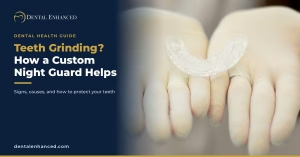
The most common cause is bruxism, or nighttime grinding. According to the National Institute of Dental and Craniofacial Research, bruxism often goes unnoticed by the person doing it, since it happens during sleep. A dentist typically spots it first through wear patterns, not because the patient reports it.
In practice, what we see most often is a patient who’s had two or three teeth chip in the same year and assumed it was bad luck. It’s rarely luck. It’s usually a bite that’s been quietly collapsing for a decade, with each chipped tooth putting more load on the ones next to it.
Multiple Fillings or Crowns Are Failing at the Same Time
One failed crown is a repair job. Three or four failing within a year or two, especially on different teeth, points to something systemic — usually a bite problem, ongoing decay under old restorations, or acid erosion from reflux or diet.
Old amalgam fillings and crowns placed 15 to 20 years ago also reach the end of their functional life around the same time, since they were often done in the same era. When several restorations fail together, patching each one individually tends to be a short-term fix that needs redoing again in a year or two.
Solutions at a Glance
- Isolated tooth wear: A nightguard plus a couple of inlays or onlays may be enough if damage is limited to 1–2 teeth
- Multiple failing crowns: Full-arch evaluation with new impressions and updated bite records before any new crown goes in
- Missing back teeth: Implant-supported crowns or a bridge, placed before front teeth start absorbing extra bite force
- Chronic jaw pain: Bite analysis first, restorative work second — treating the joint and the teeth as one connected problem
- Advanced gum disease with mobility: Periodontal treatment and stabilization before any reconstructive work is even planned
Jaw Pain, Headaches, or a Bite That Feels “Off”
Waking up with a sore jaw, tension headaches near the temples, or a sense that your teeth don’t quite meet the way they used to are classic signs the bite has shifted. This often happens gradually after losing a molar or two, since the remaining teeth drift to fill the gap.
The temporomandibular joint (TMJ) connects the jawbone to the skull, and according to the NIDCR’s overview of TMJ disorders, joint pain is frequently linked to bite misalignment rather than the joint itself being damaged. Treating the symptom with pain relievers doesn’t address the mechanical cause.
We’ve found that patients who’ve had jaw pain for over a year often assume it’s a TMJ-specific problem needing a mouthguard alone. Sometimes that’s true. But when it’s paired with several missing or heavily worn teeth, the guard only manages pain — it doesn’t stop the bite from continuing to collapse underneath it.
You’ve Lost Several Teeth Across Both Arches
Losing one tooth is a repair. Losing four or five teeth spread across the top and bottom arches changes how the whole mouth functions — chewing efficiency drops, remaining teeth take on uneven pressure, and the jawbone in the missing tooth sites starts to resorb (shrink) within months of extraction, according to research summarized by the alveolar bone resorption literature.
This is usually where dental implants come into the conversation, often combined with bridges or crowns depending on how much bone remains. Someone considering implants at this stage should read up on what’s actually involved before treatment starts — the planning process for dental implants in Las Vegas covers healing timelines and bone grafting scenarios that often surprise first-time patients.
Your Gums Bleed, Recede, or Teeth Feel Loose
Gum disease is the quiet driver behind a lot of full mouth reconstruction cases. Bleeding gums, recession that exposes tooth roots, or teeth that feel slightly loose when you bite down are signs the supporting bone and tissue are breaking down, not just the teeth themselves.
The American Academy of Periodontology notes that untreated periodontal disease is one of the leading causes of adult tooth loss. Restorative work placed on top of active gum disease tends to fail faster, which is why periodontal stabilization almost always comes before crowns, bridges, or implants — not after.
This is also where cosmetic concerns and structural ones overlap. A patient asking about a smile makeover for appearance reasons sometimes learns during the exam that recession and bite wear are the real issue, and the cosmetic result depends on fixing that foundation first.
References
- National Institute of Dental and Craniofacial Research. TMJ (Temporomandibular Joint & Muscle Disorders). National Institutes of Health. 2024.
- National Institute of Dental and Craniofacial Research. Bruxism (Teeth Grinding). National Institutes of Health. 2023.
- American Academy of Periodontology. Gum Disease Information. AAP Clinical Resources. 2025.
- American Dental Association. Full Mouth Reconstruction and Restorative Treatment Planning Guidelines. JADA. 2024.
- American College of Prosthodontists. Position Statement on Full-Mouth Rehabilitation. 2023.
This article is for informational purposes only and does not constitute professional advice. Please consult a qualified dentist for personalised guidance.
Wondering If This Applies to You?
If you’ve noticed a few of these signs together — worn teeth, jaw pain, or failing dental work — it may be worth having a dentist take a full look rather than treating each issue separately. A comprehensive exam is usually the clearest way to find out what’s actually going on and what your realistic options are.